Imagine asking an AI assistant, “What are our company's cancellation terms for annual subscriptions?” The assistant may know about common subscription practices. However, it cannot reliably explain your company's specific terms without access to the current policy.
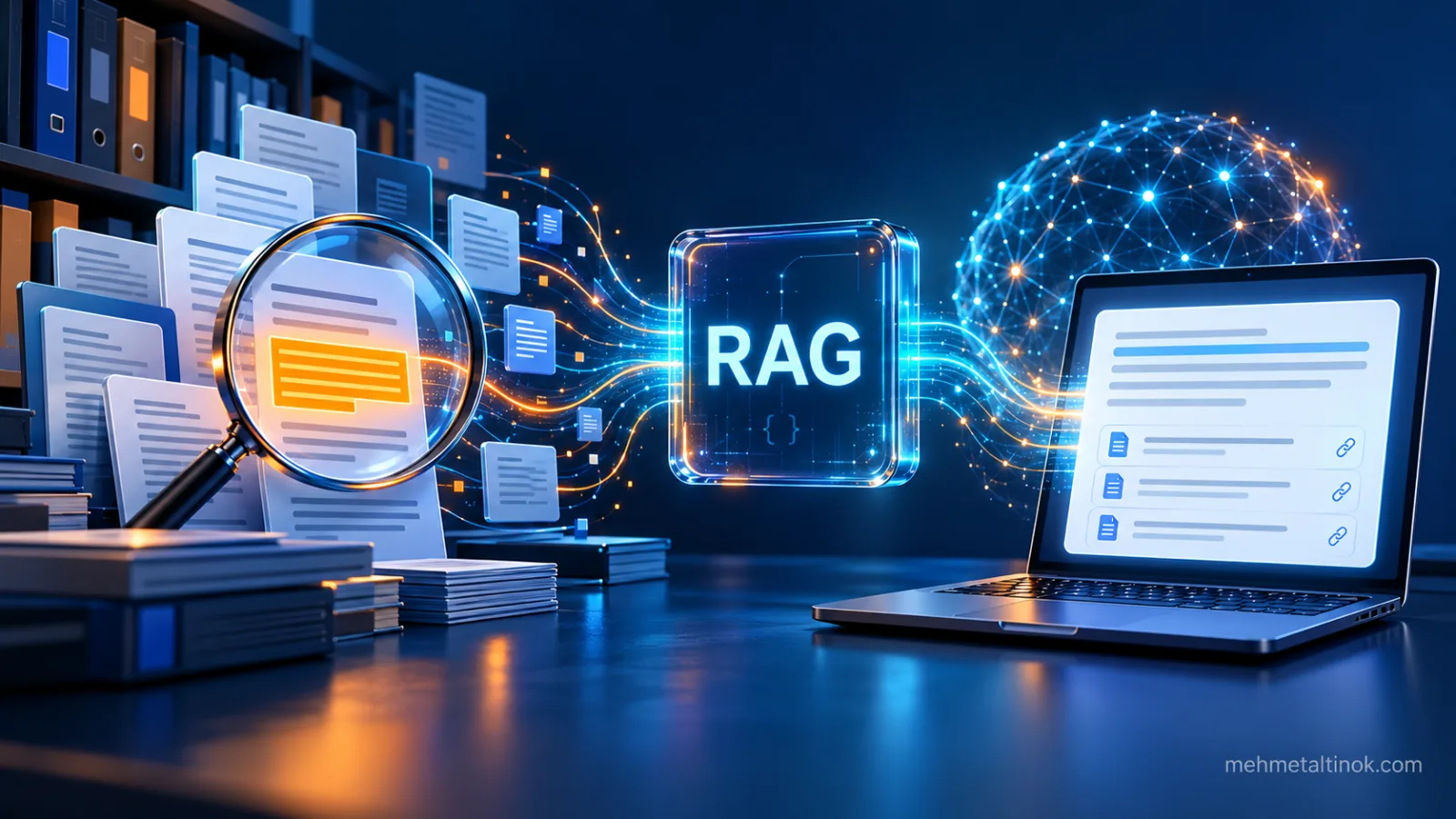
RAG is one approach to addressing this problem. Before generating an answer, the system searches relevant documents and supplies the retrieved information to a language model. The response can then draw on accessible sources rather than relying only on information learned during training.
What Is RAG?
RAG stands for Retrieval-Augmented Generation.
It combines two operations: finding relevant information and generating an answer using that information. A retrieval system locates suitable sources, while a language model uses them to produce an understandable response.
RAG is not the name of a single model or product. It is a system design that can be implemented using different search tools, data sources, and language models.
Why Does AI Need External Sources?
A language model's training data may not include your company's private documents or product terms that changed later. The model may also recall information incorrectly or generate a plausible explanation when it lacks enough evidence.
Questions such as these depend on specific sources:
- What are this product's current terms of use?
- How do employees request leave at our organization?
- Which features are available in a particular software version?
- According to the support documentation, how can this error be resolved?
RAG aims to provide the information needed to answer these questions at response time. The language model does not need to be retrained whenever a document changes.
How Does RAG Work?
A RAG application typically has two separate processes: preparing sources for retrieval and answering a user's question.
1. Preparing the Sources
PDF files, help pages, or internal documents are converted into readable text. Unnecessary repetition is removed, while information such as titles, document dates, versions, and access permissions is preserved.
Long documents are often divided into smaller passages. This process is called chunking. It allows the system to retrieve relevant sections without sending the entire document.
However, passages that are too small may lose important context. If a cancellation rule is separated from an exception immediately below it, the retrieved information may be incomplete. Document structure and section boundaries therefore matter.
2. Making Documents Searchable
The prepared content is added to a search index. The system may use keyword search, vector search, or a combination of both.
An embedding represents meaning-related features of text as a numerical vector. Vector search compares these representations to help find semantically similar content.
For example, the question “How do I end my membership?” might be answered in a section titled “Subscription cancellation.” Semantic retrieval can locate the section even when the wording differs.
Keyword search remains valuable for exact information such as product codes or error numbers. Combining keyword and vector search is called hybrid search. A vector database is not mandatory for every RAG system.
3. Retrieving Relevant Passages
When the user asks a question, the system searches sources that the user is allowed to access. Retrieved passages are ranked by relevance. An additional ranking step may help select the most useful results.
This stage is critical. Even when the correct information exists in the documents, it may not be available to the model if retrieval fails to find it.
4. Generating the Answer
The selected passages are added to the language model's context alongside the user's question. The model is instructed to answer using the sources, explain uncertainty, and provide references where appropriate.
Adding documents to the context does not mean that the model permanently learns their contents. The information is made available for generating that response.
A RAG Example in Customer Support
Suppose a software company's help document contains this example policy:
Cancelling a subscription stops automatic renewal. The user can continue accessing the account until the end of the paid period.
A user asks, “If I cancel today, will my account close immediately?” The RAG system retrieves the relevant passage, and the assistant can answer:
No. According to the help document, cancellation stops automatic renewal. You can continue using your account until the end of the period you have paid for.
A link to the document allows the user to check the basis of the answer. However, if the retrieved source does not describe refund conditions, the assistant should not invent a refund policy.
How Can RAG Improve Reliability?
RAG supplies relevant evidence to the model, helping it ground its response in accessible sources. When current documents are correctly incorporated into the search system, answers can reflect updated information.
Source references allow users to inspect the evidence. The application can also be designed to acknowledge when sufficient information is unavailable.
However, RAG does not guarantee correctness. Retrieval may select the wrong passage, a document may be outdated, or the model may misinterpret accurate text. A citation alone does not prove that the source supports the answer.
How Does RAG Differ from Fine-Tuning?
Fine-tuning updates a model's parameters through additional training examples. It can improve behavior, response format, or performance on particular tasks.
RAG retrieves external information at response time. In a typical RAG application, adding a new document does not require changing the parameters of the language model generating the answer.
RAG can supply current content from a frequently updated help center. Fine-tuning may be used to teach a particular response format. The two approaches can also be combined.
What Matters When Building a RAG System?
- Source quality: Incorrect or conflicting documents can lead to incorrect answers.
- Freshness: Changed and deleted content must also be reflected in the search index.
- Access permissions: Documents unavailable to the user must not enter the model's context.
- Instructions inside documents: Malicious commands in source text must not be treated as application instructions.
- Insufficient evidence: The system should acknowledge missing information instead of producing an unsupported answer.
A fluent response is not enough to demonstrate quality. Evaluation should separately examine whether the correct passages were retrieved, whether the response is faithful to them, and whether it answers the user's question.
Where Is RAG Used?
RAG can support product assistants, internal knowledge search, technical documentation systems, and document-based learning tools.
It is particularly useful when answers must rely on specific, accessible, and maintainable sources. A simple calculation or direct database lookup may instead be better handled by a more direct tool.
Conclusion
RAG enables AI systems to consult relevant sources before answering. The retrieval system finds information, and the language model uses that information to generate a response.
Reliable results depend on more than a capable model. Accurate sources, effective retrieval, current indexes, and access controls also matter. A successful RAG system should be able to say clearly when its sources do not contain an answer.